Updates to Tiny Cube
The "What"
The most recent round of updates to Tiny-Leaders-In-A-Box consisted of 27 cards in the "main" list, and 1.5 cards in the "commander" list. This is one of the largest updates made to the cube thus far, outside of overhauls for playability of the cube. Technically, this could be considered an "overhaul", as the primary goal was to include and support artifact synergies as part of a general transition in the cube to diversify available archetypes.
Previously, the most prevalent synergy by a wide margin has been +1/+1 counters. While each color did have other choices available, the sheer volume of cards that synergize with counters mechanics meant that regardless of the actual focus of your draft deck, it was likely that there was a much greater pool of counters-matter cards than basically anything and everything else to the point that almost every deck did something with counters. While this in itself isn't necessarily a negative, it does somewhat detract from other possible synergies, combos, and general archetypes; since counters and synergies are so prevalent, it makes any other game plan diluted and therefore worse than it could be. While counters and their synergies are a desired element of the cube for a few reasons, there needs to be room for other stuff to do.
The release of MSH/MSC, and more specifically Hawkeye's Bow was the catalyst for an awakening of sorts. The combo of Bow + Seeker of Skybreak presented an ideal combo for inclusion in the cube; the pieces are readily castable (eg inexpensive and individually not reliant on outside factors), the pieces are minimally spread across colors (compared to Thopter + Sword requiring 3 colors), they are potentially tutor-able within the pool of Tiny cards, the combo is deterministic, and it involves a degree of play/counterplay where both players have varying degrees of agency to protect or disrupt the combo.
Since BowSeeker was to be a marquee combo in a format (and cube) largely devoid of them, this naturally led to the inclusion of other cards that enable the combo without being so specific as to be otherwise unplayable. Trinket Mage, for example, fits this descriptor exceedingly well; the most available commanders are 3+ colors, and so having an enabler in a third color is not prohibitive, there is a selection of "tutor targets" within the cube Mage can find, and as a creature has a lower limit to its use-cases. Including an artifact-specific tutor also incentivizes a wider variety of utility and enabler artifacts, which contributes to the desired trend of increasing artifacts and synergies with them. This feedback loop was a major factor in the high number of card swaps within the cube.
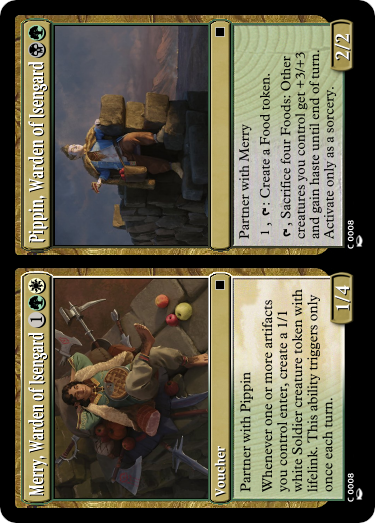
Another new "technology" also factored into the changes: CubeCobra and Draftmancer have added capability of "voucher cards". This tech enables instances of "draft packages". For example, a cube may have Tron lands in the list, and a draft caveat that drafting one of the pieces gives the player all of them (eg drafting Urza's Tower also gets you a Power-Plant and Mine). Put another way, what vouchers enable is the "tethering" of specific cards without relying on either participant memory or the alignment of randomness in a draft; by stapling two or more related cards to a voucher, a curator can guarantee access to specific groupings and by extension enable higher usability of these cards without impacting the overall draft environment. Specifically in Tiny-In-A-Box, this enables more effective use of the partner mechanic and its variations. Rather than relying on all the randomness in a draft to line up in order for a player to get Merry + Pippin as separate, individual draft pieces, a voucher means these two will always appear and get drafted together. In the future I plan to use this technology to possibly enable backgrounds.
Out with the Old
In total, 28 cards were cut from the main cube:
- Atomic Microsizer: While it may seem odd to cut an artifact while improving artifact synergies, Microsizer doesn't feed into artifact synergies. Additionally, the ability to make an attacker unblockable at the cost of its power gets worse in context; the number of "combat damage" triggers that are worth the opportunity and deckbuilding costs in itself is unfavorable, and there are other ways to "get in."
- Blade Splicer: While Splicer was a longtime staple of even powered cubes, a 3-mana 1/1 that makes singular tokens on entry has simply been eclipsed by modern design. Splicer really shines where it can be flickered/bounced repeatedly and reliably, and while both options are present in the cube either are dense enough to warrant a subpar inclusion just because the ceiling is high.
- Boomer Scrapper: Scrapper was originally intended as a sacrifice enbler/payoff and offer some degree of card advantage. However, as with Splicer, a 3-mana body in two colors that drops a strictly-worse Clue has reduced playability. Additionally, Junk tokens are not prevalent in contemporary Magic, and by extension the rules text for such tokens piles another layer of mental load and leaves more opportunity for feels-bad misplays.
- Bulwark Ox: While not a bad card, Ox is simply a victim of the shift away from counters synergies. I can easily see it making a comeback in a later update.
- Casey Jones, Vigilante: On the surface, Casey reads like a powerful effect. Drawing three cards is a rarity even among blue spells in the format. However, the drawback of discarding three at random, paired with the lack of synergistic support in red, means Casey just doesn't fit well really anywhere.
- Cathedral Acolyte: While technically another casualty of the curation philosophy shift, Acolyte is also one of the worst synergy pieces for counters; there are stronger cards to put counters on things, and ward 1 becomes trivial very quickly given the nature of the format.
- Chrome Dome: The low-cost identity of the format makes a 5-mana copy effect not nearly as appealing as almost any other action spell. That said, it's not strictly speaking a bad card or bad fit, and can very easily make a comeback in the future.
- Chrome Host Seedshark: I have consistently been underwhelmed by Seedshark's performance. Arguably it's a strong artifact enabler, but without a density of cards that care about the number of artifacts and without an "enters" ability of it's own Seedshark just isn't "up to snuff" in this environment. This assessment is highly dependent on the context of the cube, and perhaps may return later.
- Curse of Opulence: While "free" Treasures are generally pretty sweet, the extra mana is rarely relevant outside of fixing and there are more desirable means of achieving this.
- Earthbending Student: earthbend can be a powerful mechanic, however dedicating a 3-drop to give you a vigilant land creature isn't the best use of resources.
- Evendo Brushrazer: Card advantage usually is a good ability. Having to sacrifice permanents to enable it means Brushrazer is often card neutral or even negative if you can't make use of the exiled cards.
- Forsaken Crossroads: 5c lands are generically good, and this cube already has several.
- Granite Shard: Reanimator and discard synergies aren't top-of-the-pile in the cube, and Raise Dead isn't great even if repeatable.
- Grave Researcher: For the same reasons as Shard, Researcher falls short of its potential simply by virtue of what the format best enables and prioritizes.
- Hymn to Tourach: One of the most powerful discard spells in the game, Hymn is basically a victim of its own success. The swingy nature of Hymn resolutions paired with being rather new player unfriendly is why this card is out.
- Marketback Walker: Drawing a bunch of cards paired with a color agnostic body that somewhat enables itself reads like a great effect. However, with the abundance of exile effects, the difficulty in getting X to a respectable value, and the fact Marketback doesn't immediately impact the board or your hand makes it too slow to truly shine.
- Peema Trailblazer: This card is simply an experiment that fell short. There are some energy cards in the cube, but they also readily "do the thing" without the hurdles Trailblazer presents.
- Pippin, Warden of Isengard: not cut, just moved. See the next section.
- Ral Zarek, Guest Lecturer: In most cases, you're likely to get one or two activations of Ral. 3 mana for back-to-back Raven's Crime and/or surveil 2 just doesn't have enough impact to be good. It's either not worth protecting or not threatening enough to warrant removal, and will rarely be the center of loyalty management efforts.
- Rhys, the Evermore: Giving creatures persist? Almost deece. Removing counters? Almost useless. Rhys likely goes best in a dedicated aggro build, where there are simply better options for both the zone and the 49.
- Roil Cartographer: Almost the same reasoning as Trailblazer, though a more coherent landfall package may bring it back.
- Sam, Loyal Attendant: Sam wants to be with Frodo, and Frodo is not being considered for inclusion. Life gain and Food synergies are not dense enough for Sam to be good by himself.
- Shoreline Looter: A simple, highly useful, solid effect on an unblockable body. However, it's a 1/1. If Merfolk Looter and Looter il-Kor aren't good enough, then it becomes apparent Shoreline isn't either.
- Tale of Katara and Toph: Scaling back counters synergies, and while it's a cool card room must be made.
- The Last Agni Kai: Also a cool card, and spot removal is always premium. A fight in red is mediocre and the possible mana bonus is both rarely proc'd and rarely relevant.
- The Ooze: There doesn't need to be a plethora of grave-hate pieces, of which The Ooze is the least powerful, and the scaling back of counters-matter makes the Mutagen tokens less desirable.
- Travelling Chocobo: Removing the undersupported landfall package, and the fact there are so few Birds, make Chocobo less appealing. The actual cost of the card factored in, as expensive pieces that aren't super relevant is also undesirable.
- Zero Point Ballad: There are a few sweepers, and I'm not yet contemplating adjusting that number. Ballad gets cut to make room for something new.
The commander list has one change:
- Doran, the Siege Tower: "big butt" effects are less relevant in a format where most creatures have toughness equal to their power. Originally included as one of the better Abzan options, the implementation of voucher tech allows for easy (and improved) substitution.
In with the New
As with removals, there are 28 mainboard changes, and one to the commanders:
- Aether Hub: A 5c land, Hub is more aligned with energy enablers/payoffs than simply doing all the colors. Unlike Trailblazer and Cartographer, Hub is very easy to enable, including the ability to immediately enable itself.
- Attune with Aether: An unobtrusive energy enabler, Attune has the floor of fixing mana and thinning the deck (however slightly). Enabling energy is more useful side effect than primary purpose.
- Banefire: X spells are nice in a mana value-restricted format. Banefire scales with the game, and the facts it can easily be made uncounterable and hit any target make this an appealing spell. It also serves as a mana sink/wincon for Zirda combos.
- Basalt Monolith: Included solely for combo with Kinnan or Zirda. Enabling X spells is a delightful side effect.
- Claim the Firstborn: Threaten effects can be very strong contextually. However, as the effect is only as strong as the boardstate it gets played to, it's difficult for these effects to becomes oppressive. Particularly in this environment, Claim seems like a natural inclusion.
- Day of Black Sun: A bit better more often than Ballad, DoBS is simply an "upgrade," though can also be replaced by a number of options.
- Day's Undoing: In the service of adding more combo elements to the cube, Day's Undoing is both a combo piece and a combo enabler.
- Drown in Dreams: Modal spells are good. X spells are great. Particularly spells in either UG or WR identities.
- Finale of Devastation: Another big mana payoff, Finale has the added benefit of being able to end games on the spot and serve as an alternative to Green Sun's Zenith.
- Gadwick, the Wizened: Black has typically been the best color for Tiny; the utility of black's effects at lower values make it a powerful and flexible option. Gadwick is an attempt to give blue more weight, and serves as a mana sink.
- Golden Egg: A strictly-worse Chromatic Star, Egg nonetheless fills largely the same role.
- Grim Monolith: Same reasoning as Basalt.
- Hawkeye's Bow: A cheap combo piece that can be played to the board for a variety of reasons, as well as both an artifact and aggro enabler.
- Heartbeat of Spring: Another big mana enabler, meant to synergize with the influx of X spells.
- Inventor's Fair: Artifact synergies and an uncounterable tutor.
- Kinnan, Bonder Prodigy: Big mana enabler and combo piece that can sit in the zone.
- Kozilek's Command: Yet another X spell, KozCommand has the unique benefit of being the only colorless option.
- March of Otherworldly Light: Cheap, instant-speed removal that hits many of the combo pieces and enablers.
- Natural State: An increase in combo lines means there should be a decent amount of counterplay. Natural State is a near-perfect fit for the format.
- Seeker of Skybreak: A flexible combo piece, Seeker can also enable a breadth of creature-based shenaniganry.
- Sevinne's Reclamation: While reanimator isn't a great archetype in Tiny, recursion that itself has some recursion is quite useful, particularly when that recursion can get a variety of card types.
- Tamiyo's Safekeeping: mainly a protective piece for combos, the alternate mode of conditionally countering a spell makes it quite flexible.
- Tarmogoyf Nest: Goyf is great. Goyf on demand is better. Green has historically been underpowered in this environment, and so an effort is being made to improve green's capabilities.
- Tempt with Vengeance: X spell.
- Tocasia's Welcome: Card draw in white? Sure why not.
- Trinket Mage: Flexible synergy and combo enabler.
- Wrath of the Skies: Another energy enabler/payoff, Wrath is unique in its ability to sweep noncreature permanents.
- Zirda, the Dawnwaker: A combo enabler/piece that can sit in the zone or act as companion is well worth the experimental inclusion and it's risks.
The command zone got one change:
- Voucher for Merry, Warden of Isengard + Pippin, Warden of Isengard: vouchers enable "tethered" picks in draft. This makes partners much more viable.
You may notice a large portion of the includes are X spells. Not only do X spells scale well with games, they are also one of the few ways to make use of the greater mana available due to longer games. Additionally, most of these are restricted to UG or RW identities. This biased trend is to make maximal use of Zirda and Kinnan alongside the Monoliths. The potential oppressiveness of combos with pieces that can sit in the zone is ideally offset by the need to include payoffs, and by the pre-game declaration that one is playing a combo deck (revealing a commander or companion).
As always, this cube is a living work. As sets I care about get released, and the context of the cube changes, there will always be room for improvement toward a fun, engaging, and inviting experience; the ultimate "goal" of cube being "the most fun for the most people."
Until next time, stay safe, be well, and be good to each other.
Gray | Judge Dad